Success in knitting, you see, is a relative thing. There are times when I "try, try again" because the pattern is rubbish (my own or someone else's even) and times when it takes me forever to finish because I'm just not feeling it.
It's not that I don't knit at a relatively decent speed, it's more that I keep remembering something my great-grandmother made or showed me how to make, stitches she used, cast ons and offs, the way she told me to hold my yarn -- these things are treasures buried in my memory. Lost for years, they tend to come to light half way through a project, changing everything.
Suddenly the perfectly fine way the modern pattern or youtube video says to do it isn't nearly as neat (Granny was strict about having a neat back and front to your knitting), or easy (you simply cannot beat years and years of accumulated tricks and tips that get handed down from knitter to knitter), or right as the way she taught me all those years ago. I become dissatisfied with the work, rip it out, and start again.
In the end, I want my finished pieces to look like they could have come off of her needles. Like they carry on the traditions she learned as a child at her granny's knee and passed on to me when I was a wee one at her knee. As though these American born designs of mine have that soft, slightly Scottish accent tying them to my heritage and the long line of talented women who somehow knit my DNA from their own.

Showing posts with label original pattern. Show all posts
Showing posts with label original pattern. Show all posts
Monday, April 18, 2016


Friday, April 1, 2011
Father's Heart Quilt
 ~ sketch and calculate ~
  ~machine pieceing ~
 ~ center panel tree ~
  ~ freehand machine quilting ~
 ~ straight grain quarter inch binding ~
  ~ label and hanging sleeve on back ~
  ~ quilt getting raffled tonight ~
 Friends of mine are putting on a talent show and raffle to raise money to benefit Father's Heart Foundation please follow link to learn more about the plans to build family-modeled, sustainable orphanages in El Salvador.
Tuesday, December 28, 2010
Father Abraham
I finally got my computer and phone to talk to each other. Which means, finally, I can post pictures of my Sparkies Stars bulletin board.
The story was Abraham and Isaac -- God's promise of nations and peoples as numerous as the stars, all descended from Abraham. Explaining this concept so five-year-olds could remember it seemed like it might require a game.
The sort of game where they have to guess how many stars there are... there were 96 blue stars, 28 stars that I painted with a special paint so they glow in the dark (they loved that), 154 total 3D stars (there are more stars printed on the fabric background)...
 and one Abraham standing on a small green hill in the bottom right corner looking on in amazement.
 God took Abraham outside and said "Look up at the sky and count the stars -- if indeed you can count them." Then God said to him, "So shall your offspring be." Genesis 15:5
The story was Abraham and Isaac -- God's promise of nations and peoples as numerous as the stars, all descended from Abraham. Explaining this concept so five-year-olds could remember it seemed like it might require a game.
The sort of game where they have to guess how many stars there are... there were 96 blue stars, 28 stars that I painted with a special paint so they glow in the dark (they loved that), 154 total 3D stars (there are more stars printed on the fabric background)...
 and one Abraham standing on a small green hill in the bottom right corner looking on in amazement.
 God took Abraham outside and said "Look up at the sky and count the stars -- if indeed you can count them." Then God said to him, "So shall your offspring be." Genesis 15:5
Monday, November 22, 2010
A Smug Little Pillow

 So few things that I've been making lately can be put up on this blog. Christmas presents are in full swing but since my family occasionally read this blog it's not safe to post photos of their Christmas gifts until after Christmas.
Ergo, random postable project: this fat little two-sided throw pillow. Just because.
Thursday, September 9, 2010
IQ: Carpenter's Squares
From my latest IQ (infant quilt) class comes Carpenter's Squares. Based on a traditional quilt block rich in symbolism, the design has been enlarged and modernized. The L shaped tool known as a carpenter’s square has been used for centuries to help square-up and measure in carpentry. Early quilters of the traditional (much smaller) block recorded their beliefs in this block, referencing Jesus as The Carpenter.  Harking back to traditions in early Gaelic Christianity, Celtic interlace represented the way in which all life is woven together. The interlace patterns represented in this design symbolize the idea that the afterlife (heaven) and this present world (earth) intersect creating a pattern that, at least for now, only God the Creator sees the whole of.
The use of triple bands to create the interlace in this design also suggests the Trinity, a concept of the Father, Son, and Holy Spirit together as One. Another use of religious symbolism is seen in the repetition of the four isolated background squares in each corner. This design feature suggests a relationship to the idea of the “foursquare gospel” (meaning a good foundation for one's faith), terminology borrowed from the Biblical book of Revelations.
 Harking back to traditions in early Gaelic Christianity, Celtic interlace represented the way in which all life is woven together. The interlace patterns represented in this design symbolize the idea that the afterlife (heaven) and this present world (earth) intersect creating a pattern that, at least for now, only God the Creator sees the whole of.
The use of triple bands to create the interlace in this design also suggests the Trinity, a concept of the Father, Son, and Holy Spirit together as One.
Another use of religious symbolism is seen in the repetition of the four isolated background squares in each corner. This design feature suggests a relationship to the idea of the “foursquare gospel” (meaning a good foundation for one's faith), terminology borrowed from the Biblical book of Revelations. To make the quilt shown in this post I used a dark purple reproduction fabric from P&B for the background, with a Michael Miller Asian print and one of Northcott's Quilt for A Cure(TM) fabrics as the bands. Machine quilted in a random free-motion swirliness.  The combination of these fabrics, I think, is visually striking but also speaks to diversity -- reminding me that there are many different people with many different backgrounds, talents, and gifts who come together to make up the beauty of the body of believers.
Wednesday, June 30, 2010
Carpenter's Squares
Graphic of quilt design for the quilt class I'm teaching in August:
From the class description:

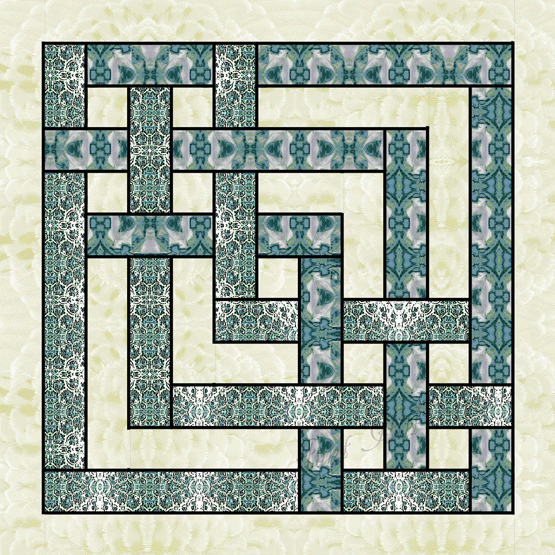
~Carpenter's Squares Infant Quilt ~
From the class description:
The woven bands of the Carpenter’s Squares create a high graphic design with a modern, a classic, even a Celtic appeal which looks difficult to do, but really isn’t. Once you know the secret of creating consistent T-seams this infant quilt top becomes so simple, beginning quilters can confidently piece it. More experienced quilters will also find this quilt top an excellent opportunity to practice “pinless seaming” a speed construction technique using very few pins.The "sample quilt" made up to help advertise the class:

Tuesday, June 29, 2010
Outside the Lines
 I started off quilting in straight lines. Two inches apart, respectably thorough but not too dense. Faster on a hot day. Simpler and faster on a project I want to finish quickly. But I got bored.
Like crop circles suddenly appearing in a field of neatly planted straight rows, freehand quilting curlicues suddenly erupted to decorate the last corner of the quilt. I suppose I should know better... never settle for boring rows when arabesques and scroll-work are an option.
Tuesday, June 22, 2010
Photo Shoot
I finished piecing another sample top for my Counting House (full) quilt yesterday. And having actually managed to hang onto the Sixpence (infant) quilt I finished a few weeks back --finished quilts have the oddest habit of getting up and walking out my door-- I decided to do a photo shoot this afternoon to get some cover pics for the pattern.
 the view from on high
 pattern cover photo option #1
 pattern cover photo option #2
 Which photo do you like best?
behind the scenes
 the view from on high
 pattern cover photo option #1
 pattern cover photo option #2
 Which photo do you like best?
 Leave a comment or just vote for your favorite in the poll on the sidebar.
Tuesday, April 13, 2010
Sing a Song of Sixpence
 front of Sixpence quilt
 Counting House, the full-size quilt pattern got shrunk last week, into a mere Sixpence. That was the easy part. The new baby-size quilt design went together smoothly and I had a blast picking out the color pallet.
Then I decided to machine quilt in "bubbles" (aka "river rocks") a freehand machine quilting design that is.... well, it uses a lot of thread.
 close up of freehand "bubbles" machine quilting
I had to make a run to the shop for more thread half way through.
Seven empty, brand-new spools of thread later it was done. Took me twice as long to quilt it as to piece it in the first place. But I do love the texture of a heavily quilted quilt.
 back of quilt
The Nursery Rhyme
Sing a song of Sixpence, pocket full of rye
Four and twenty blackbirds baked into a pie,
When the pie was opened the birds began to sing.
Wasn't that a dainty dish to set before a king?
The king was in the Counting House, counting out his money.
The queen was in the parlor eating bread and honey.
The maid was in the garden hanging out the clothes,
When down came a blackbird and nipped off her nose.
The king called his doctor who sewed it on again
He sewed it on so neatly the seam could not be seen.
Sing a song of Sixpence pocket full of rye,
Four and twenty blackbirds baked into a pie.
Monday, March 8, 2010
Flannel Princess Gown
She will be three next month. Her big sister is already in possession of a similar blue flannel gown "Big enough to fit next year too. With ribbons and lace." as specified.
 It had to be flannel. They all want flannel.
...with puffed sleeves... "It would probably be better if you just made it and gave it to me. I don't think I should help." had said the six, now seven year old, while the little one snuggled into my shoulder and said "yeht."
 Birthday presents done.
Thursday, March 4, 2010
Polkadot Platypus
 Sometimes you don't get it right the first time. This is not a duck.
 It was supposed to be a duck -- but it went wrong somewhere.
 My sister had a conversation with it and evidently it is a platypus.
 So there we are. Polkadot Platypus prototype done, and pattern almost finished. I'll have a pdf available soon for anyone who wants a platypus of their own.
Tuesday, December 8, 2009
Blue Hoo
Can you guess what this is?
 From the back it's hard to tell. Here's a hint.
 That's right. It's BLUE HOO.
 Future owls are planned, among them: Bally Hoo, You Hoo, Wa Hoo, Hoo Cares, and You Know Hoo.
 Tuesday, November 17, 2009
FourSquare and Seven
Another NEW Quilt Pattern is out!
The pattern includes:
Everett’s Address
PIECEFUL SLUMBER PATTERNS ARE AVAILABLE THROUGH NEEDLE AND THREAD IN GETTYSBURG PA. [They ship phone orders.]

The pattern includes:
Everett’s Address
 Before Lincoln’s brief speech dedicating the Soldier’s National Cemetery at Gettysburg on November 19th 1863, the famous orator Edward Everett delivered a 13,000 word speech. Everett (1794-1865) was a Whig Senator from Massachusetts, former president of Harvard University, and served as Secretary of State under Millard Fillmore.
Everett’s two hour speech began: “Standing beneath this serene sky, overlooking these broad fields now reposing from the labors of the waning year, the mighty Alleghenies dimly towering before us, the graves of our brethren beneath our feet, it is with hesitation that I raise my poor voice to break the eloquent silence of God and Nature.”
Lincoln's Address “Four score and seven years ago our fathers brought forth on this continent a new nation, conceived in Liberty, and dedicated to the proposition that all men are created equal.
“Now we are engaged in a great civil war, testing whether that nation, or any nation, so conceived and so dedicated, can long endure. We are met on a great battle-field of that war. We have come to dedicate a portion of that field, as a final resting place for those who here gave their lives that that nation might live. It is altogether fitting and proper that we should do this.
“But, in a larger sense, we can not dedicate...we can not consecrate...we can not hallow this ground. The brave men, living and dead, who struggled here, have consecrated it, far above our poor power to add or detract. The world will little note, nor long remember what we say here, but it can never forget what they did here. It is for us the living, rather, to be dedicated here to the unfinished work which they who fought here have thus far so nobly advanced. It is rather for us to be here dedicated to the great task remaining before us—that from these honored dead we take increased devotion to that cause for which they gave the last full measure of devotion—that we here highly resolve that these dead shall not have died in vain—that this nation, under God, shall have a new birth of freedom—and that government: of the people, by the people, for the people, shall not perish from the earth.” -- Abraham Lincoln
Remembrance Day In the town of Gettysburg we find the tradition continues. Each November parades of Civil War re-enactors fill the streets, living history demonstrations and tours pack the National Park, while every hotel in town boasts a conference room turned period ballroom hosting a Remembrance Day Ball. At the appointed time Abe Lincoln, or his double at least, proceeds up Baltimore Street from the Wills House to the National Cemetery to deliver his famous address once more.
PIECEFUL SLUMBER PATTERNS ARE AVAILABLE THROUGH NEEDLE AND THREAD IN GETTYSBURG PA. [They ship phone orders.]
Tuesday, November 10, 2009
Gettysburg Town Square
 Today the town of Gettysburg sits, as it always has, on the intersection of several major highways, like a spider at the center of a web. In the summer of 1863, at the height of the Civil War, Confederate and Union soldiers caught in that web would find themselves fighting one of the bloodiest battles of history. In just three days the battle of Gettysburg resulted in over 46, 000 American casualties -- 7,863 dead and 27,224 wounded.
Meant to relieve the battle-weary southern states and resupply Confederate soldiers with bounty from rich northern farms, General Lee’s northern campaign became the most decisive turning point of the Civil War. Nearly a third of Lee’s officers were killed, captured, or wounded. Abandoning the Pennsylvania Campaign, the South retreated and for the remainder of the war Lee planned no more strategic offensives into northern territory.
On July 1st 1863 the battle began. The two armies, led by General Lee (CSA) and General Meade (USA), collided in the low ridges to the northwest of town. Buying time until reinforcements could arrive, Union cavalry and infantry forces laid out defenses on Herr’s Ridge, McPherson’s Ridge, and Seminary Ridge. Stronger Confederate forces attacked from the north and west collapsing Union lines and sending the soldiers retreating to the hills south of Gettysburg, taking the battle along the web of roads through the town itself. This quilt square takes its inspiration from those historic streets. From the intersections of highway and history that make up the town of Gettysburg.
PIECEFUL SLUMBER PATTERNS NOW AVAILABLE THROUGH NEEDLE AND THREAD IN GETTYSBURG PA
Monday, July 13, 2009
S is for Sockies
 Sockies -- a sock style baby bootie. This is my attempt to re-create the pattern for "The best booties Granny ever knit for you..." as remembered by my Mum. My earliest memories, unfortunately, do not include patterns for the booties I wore as an infant.
 The Opal self-striped sock yarn I used will also make a pair of matching "big sister socks" (half done already, as you can see in the above photo). If you are familiar with knitting and Opal's "Sock Philosophy" these baby sockies are an easy adaptation and knit up quick.

SOCKIES:
Use a size 3 (US) needle and Opal self-striping sock yarn.
Cast on 36 stitches -- 12 per needle on 3 needles. (12/12/12)
Rib knit (k2, p2) for about an inch and a half.
Knit 3 rounds in stocking knit.
In the next round begin buttonholes (by casting off) -- 6 total holes-- 2 per needle -- 3 stitches each at end of round each needle should look like this IIxxxIIxxxII (I = stitch x-cast off stitch)
In the next round finish the buttonholes by casting on the missing stitches as you knit the round.
You should have 36 stitches again.
Knit a couple more rounds as desired and split for heel flap. Two needles for instep should have 9 stitches each. Heel flap (all on one needle) should have 18. (9/9/18)
Work heel flap (roughly square).
Turn heel: k9, k2t, k1, turn, s1,p1, p2t, p1, turn, s1...and so on. End on knit row.
Pick up 10 on gussets.
Begin reduction: Reduce at heel as normal AND reduce at sides of instep also (-4 per reduction)
Alternate rounds plain knit, then reduction until you have reduced to 24 stitches remaining.
Knit 3 rounds plain stocking knit.
Split for toe -- keep 6 stitches on each top needle and 12 stitches on bottom. (6/6/12).
Reduce toe until only 8 stitches remain (2/2/4) -- last knit round put onto 2 needles (4/4).
Finish with the Kitchener stitch.
Run a narrow grosgrain ribbon through the button holes, turn down the cuff, and there you have it.
Note to beginning knitters: If you've never knit socks before, baby socks are a great place to start. But these Sockie instructions are incomplete, abbreviated for those familiar with sock knitting. For a first attempt at baby socks I recommend the very thoroughly explained North Country Baby Sock pattern.
Friday, May 15, 2009
Thief in the Night

I took a day and sewed up some projects I've been meaning to do for a while, including some samples of the quilt blocks I designed a while back for a quilt shop. This block is called Thief in the Night. I did four blocks each in two different samples:
 Random Scrappy Bright Sample.
 Controlled Coordinated Blues Sample.
Wednesday, February 4, 2009
The Six Month Socks
Six months old baby, that is -- these socks won't take six months to knit. For those of you who knit, I'll backtrack to the pattern in a little bit.
For those of you who Don't knit we're skipping straight to the part where, unlike the first pair that were too small, THIS PAIR FITS! Hooray!
I took a bunch of pictures of baby feet. If anyone needs some photos of motion blurred yellows socks I have plenty. In the two seconds we could manage to get the wee one's feet to hold still I managed to capture this photo.

I used the leftover wool/cotton/soy sock yarn and five size 2 (US) sock needles.
My "pattern" (which I admit is half guesswork and half borrowing from various "sock philosophies") goes something like this:
Cast on 30 stitches, knit back dividing the stitches onto three needles (10 stitches each). Then making sure you are not twisted anywhere join the rounds.
Row 1: k2 p1
Row 2: knit
Row 3: Begin k3 p2 -- continue until you have two inches (babies like to pull their socks off so a little longer is better at this stage).
Divide for Heel: knit 15 stitches onto one needle, purl back. Knit row, purl row, until you have a 1 inch heel flap.
Turn Heel:
Row 1: s1, k7, k2together, k1, Turn
Row 2: s1, p2, p2together, p1, Turn
Row 3: s1, k to one before the last turn, k2together, k1, Turn
Row 4: s1, p to one before the last turn, p2together, p1, Turn
repeat rows 3 and 4 until you are to the edges -- you should have 9 stitches on the needle. This will be needle 1. Knit a plain row across.
Begin Gusset:
Pick up stitches on the side of heel flap (should be 11 stitches if you pick up 2 at the corner), This will be needle 2.
Knit plain across the top of the foot. Putting those 15 stitches all onto needle 3.
Pick up same number (11) of stitches on the other side of the heel flap. That will be on needle 4.
Knit one round and then begin shaping the gusset.
Round 1: Knit to last 3 stitches on needle 2, k2together, k1. Knit across needle 3/top of foot. On needle 4, k1, s1, k1, psso and knit the rest of the needle.
Round 2: knit plain.
Repeat rounds 1 and 2 until there are only 3 stitches each on needles 2 and 4. Thirty stitches total.
Reposition stitches from needles 1, 2 and 4 onto just 2 needles (the top of the foot stays on one needle).
Knit plain for about an inch more -- this really depends on the length of the baby's foot, I only needed 3 inches total length. (The following toe shaping is about half an inch in length.)
Reduce for the Toe:
Round 1: From center of heel knit to last 3 stitches on the needle, k2together, k1. Begin next needle with k1, s1, k1, psso, knit across top of foot to last 3 stitches, k2together, k1. Then k1, s1, k1, psso, and knit to center of heel.
Round 2: knit
Reduce to 18 stitches and finish last round out to the side of the foot so you have 9 stitches each on 2 needles. Use a tapestry needle and a Kitchner stitch to close the toe.
Knit second sock exactly the same.
For those of you who Don't knit we're skipping straight to the part where, unlike the first pair that were too small, THIS PAIR FITS! Hooray!
I took a bunch of pictures of baby feet. If anyone needs some photos of motion blurred yellows socks I have plenty. In the two seconds we could manage to get the wee one's feet to hold still I managed to capture this photo.

I used the leftover wool/cotton/soy sock yarn and five size 2 (US) sock needles.
My "pattern" (which I admit is half guesswork and half borrowing from various "sock philosophies") goes something like this:
Cast on 30 stitches, knit back dividing the stitches onto three needles (10 stitches each). Then making sure you are not twisted anywhere join the rounds.
Row 1: k2 p1
Row 2: knit
Row 3: Begin k3 p2 -- continue until you have two inches (babies like to pull their socks off so a little longer is better at this stage).
Divide for Heel: knit 15 stitches onto one needle, purl back. Knit row, purl row, until you have a 1 inch heel flap.
Turn Heel:
Row 1: s1, k7, k2together, k1, Turn
Row 2: s1, p2, p2together, p1, Turn
Row 3: s1, k to one before the last turn, k2together, k1, Turn
Row 4: s1, p to one before the last turn, p2together, p1, Turn
repeat rows 3 and 4 until you are to the edges -- you should have 9 stitches on the needle. This will be needle 1. Knit a plain row across.
Begin Gusset:
Pick up stitches on the side of heel flap (should be 11 stitches if you pick up 2 at the corner), This will be needle 2.
Knit plain across the top of the foot. Putting those 15 stitches all onto needle 3.
Pick up same number (11) of stitches on the other side of the heel flap. That will be on needle 4.
Knit one round and then begin shaping the gusset.
Round 1: Knit to last 3 stitches on needle 2, k2together, k1. Knit across needle 3/top of foot. On needle 4, k1, s1, k1, psso and knit the rest of the needle.
Round 2: knit plain.
Repeat rounds 1 and 2 until there are only 3 stitches each on needles 2 and 4. Thirty stitches total.
Reposition stitches from needles 1, 2 and 4 onto just 2 needles (the top of the foot stays on one needle).
Knit plain for about an inch more -- this really depends on the length of the baby's foot, I only needed 3 inches total length. (The following toe shaping is about half an inch in length.)
Reduce for the Toe:
Round 1: From center of heel knit to last 3 stitches on the needle, k2together, k1. Begin next needle with k1, s1, k1, psso, knit across top of foot to last 3 stitches, k2together, k1. Then k1, s1, k1, psso, and knit to center of heel.
Round 2: knit
Reduce to 18 stitches and finish last round out to the side of the foot so you have 9 stitches each on 2 needles. Use a tapestry needle and a Kitchner stitch to close the toe.
Knit second sock exactly the same.
 Knitting Codes Decoded:
k = knit
p = purl
s = slip
(and the number following tells you how many of those stitches to make or slip)
k2together = knit 2 stitches as though they are one stitch
p2together is the same thing but purl
psso = pass slipped stitch over. So you slip one then knit one and then slide the slipped stitch over that one you just knit.
Friday, October 24, 2008
Peek at the Projects
 One of the designs I've created for the kits I'm calling Counting House. It uses blocks of various quilting "coins" an idea inspired by the nursery rhyme phrase "The King was in the counting house, counting out his money..."
As the quilts are meant to be easy (or beginner) the most complicated blocks in the whole thing are the Coin of the Orient block -- shown above. As you can see I'm using a pallet of red and green and white for the sample I'm doing up.
Wednesday, July 30, 2008
Northwoods Baby Quilt

I just finished pin-basting this machine applique northwoods baby quilt. I love to make heirloom pieces and generally hand quilt the baby quilts I make, but an overwhelming sense of irony confronts me when I consider hand quilting a machine applique top. Machine quilting just seems more fitting.
The applique blocks are embellished with a fabric paint pen for the eyes, hooves, etc. and the designs I pulled out of the sashing fabric. I have always loved the little birds especially, and although I have no more of that sashing fabric, I foresee another all cardinals quilt in the future. (maybe bluejays -- they have those tufts too)
 It was easy enough to draw out a larger version of the simplistic but adorable animals (and a tree). The buttonhole stitch effect I achieved with a blanketstitch setting on my machine and a rayon thread. If I had wanted to do a larger quilt there were also canoes and snowshoes and cute little cabins to choose from. But I chose a Bird:
 A Bear: [He's tan in the sashing fabric but I chose a brown and black calico for the applique -- it just looked more bear-ish to me, you'll notice it also looked more tree trunk, twig, and antler-ish to me as well.]
A Moose:

And an Evergreen Tree:

And I'm backing it with flannel. Snuggly, northwoodsy flannel, I just know that will make this a favorite quilt with the little ones.
Subscribe to:
Posts (Atom)